Introduction to network econometrics
A 6-hour course as an introduction to models and estimators to analyse network data intended for advanced undegrad or postgrad students..
The course is structured in 3 modules of 2 hours each. All modules contain an expositional part and then a learning-by-doing part where students work on estimation or simulation of the models.
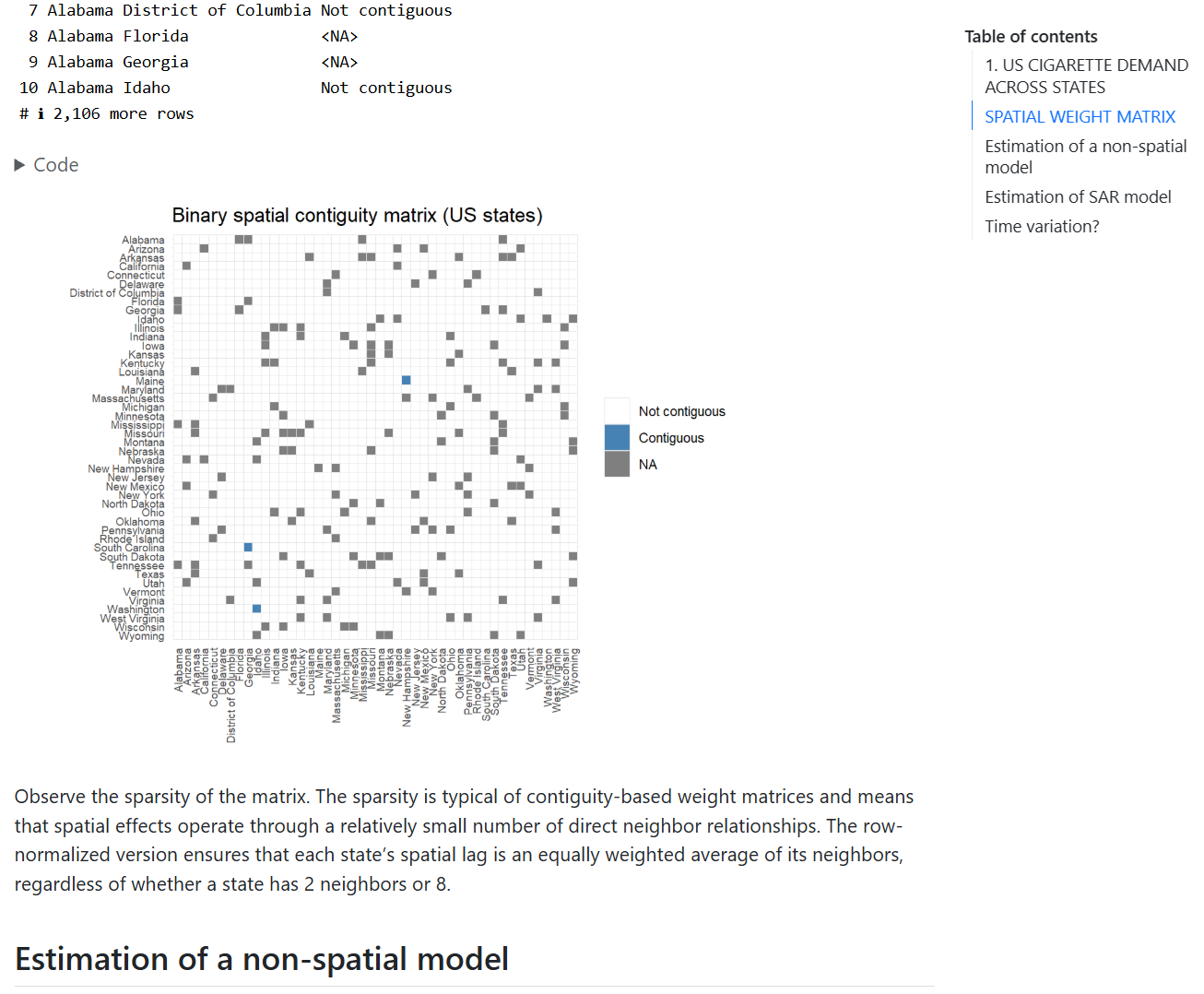
Learning by doing. The first activity in a Quarto Markdown document shows estimation in a classical study of US cigarrette demand. .
The first module focuses on the motivation for network models with examples and studies reduced-form models. It builds on the spatial autoregressive model, including marginal effects, to conclude with the spatial Durbin model. It focuses on cross-sectional models with an exogenous (predetermined) network. Discussion on estimation is postponed to the second module. The goal is that students can interpret the models.
The second module brings a stronger connection with economic theory, appealing to quadratic network games, which allows interpreting the models discussed in the previous module as structural models and facilitates the discussion on identification. Then the module focuses on estimation assuming a predetermined network. It discusses the classical maximum likelihood approach and the recent developments of GMM estimators. The discussion on GMM estimators builds a bridge to the next module, where an endogenous network is briefly discussed.
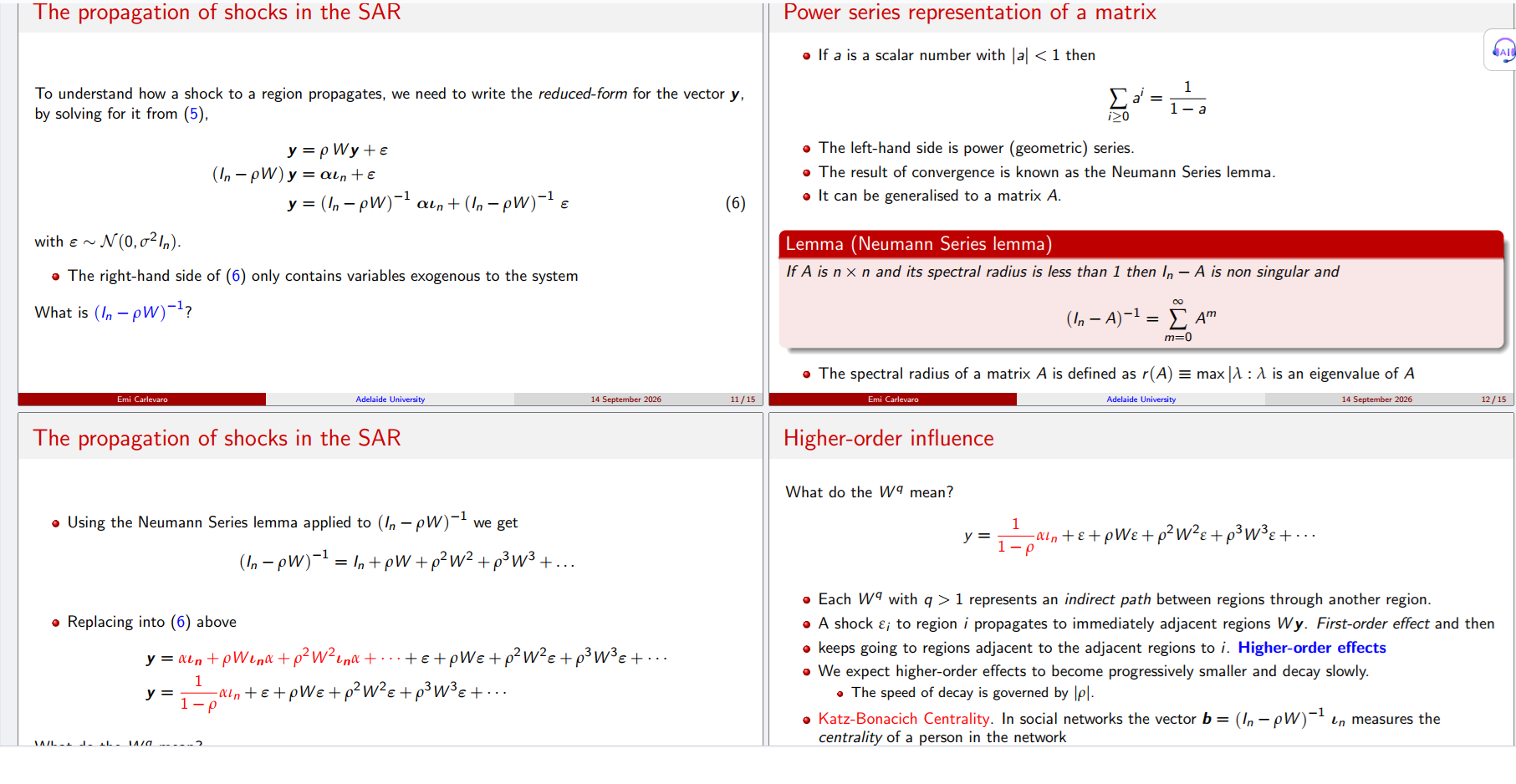
Module 1. Some slides of Module 1 covering in some detail the propoerties of the spatial autoregressive model.
The third and last module discusses selection of the network (spatial matrix) when many are available. An overview of estimation of models with limited dependent variables, panel data with fixed effects, and a dynamic spatiotemporal model. The module concludes with a discussion of an estimator with an endogenous network.
At minimum, the course assumes a student has taken an introductory course in econometrics and an introductory course in economics. Ideally, a student has some understanding of maximum likelihood estimation, basic linear algebra covering matrix multiplication and eigenvalues, and game theory, particularly the concept of Nash equilibrium.
All course material is done using R software.